
7 Tips for Choosing the Right Case Packer?
Choosing a case packer is not simply a matter of selecting the fastest machine on a supplier’s brochure. The right equipment must handle your products, cartons, production targets, and available floor space. A line packing lightweight pouches has different needs from one loading heavy jars or fragile bottles. Small details matter. Carton dimensions, product orientation, and changeover frequency can affect daily performance as much as rated speed.
This guide explores seven practical considerations for evaluating a case packer, from packing style and throughput to controls, maintenance, and supplier support. Look closely at what happens during a real shift: how often operators adjust guides, how easily a jam can be cleared, and whether format changes require special tools. Ask suppliers to demonstrate your actual product and packaging when possible. A polished demonstration helps, but it may not reveal every production challenge. In practice, even a careful estimate can miss an awkward carton or a cramped service aisle. That is worth checking before committing. The best choice is usually the machine that fits your operating conditions reliably, not the one with the most impressive headline speed. Decisions should be based on verified specifications, realistic trials, and the people who will run and maintain the equipment.
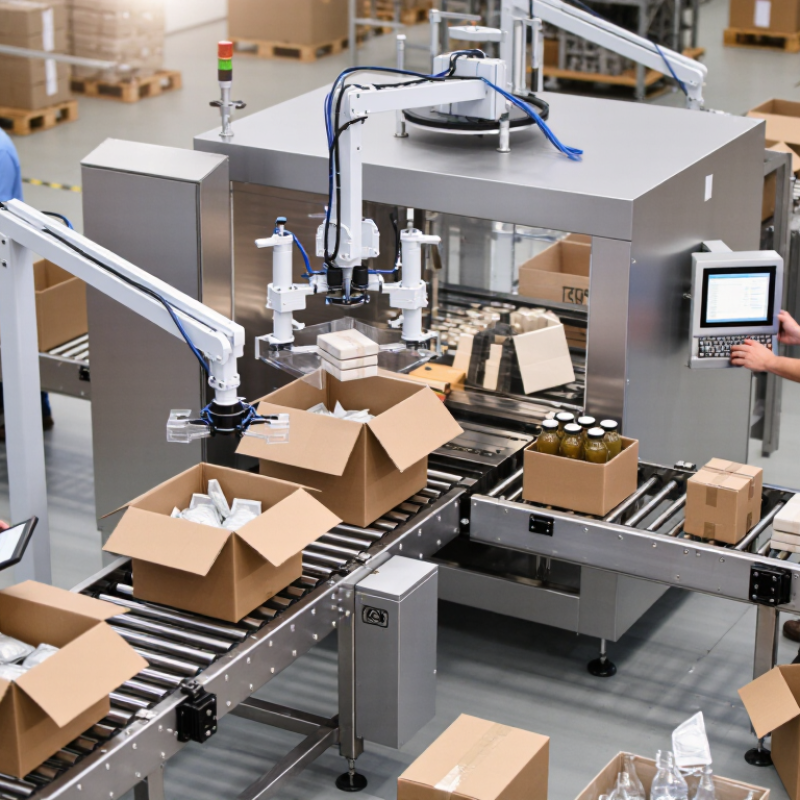
Understand Your Products, Cases, and Packaging Requirements
Choosing a case packer starts with the product, not the machine’s headline speed. Record each item’s length, width, height, weight, and permitted orientation. Small differences matter. Also check fragility, surface friction, temperature, and whether products arrive consistently spaced. A soft pouch behaves differently from a rigid carton, even when their dimensions match.
Measure the case inside, not just its outside. Confirm its style, board strength, flap overlap, closure method, and acceptable empty space. Run real products through sample cases and watch for scuffing, tipping, crushed corners, and awkward handoffs. PMMI’s 2023 State of the Industry report put U.S. packaging machinery shipments at $10.9 billion in 2022. That scale makes fit testing worthwhile.
Match the machine to your target rate and actual changeover frequency. Ask for tests using your least stable product and smallest case, not only an ideal sample. Inspect filled cases after conveying and stacking; small gaps can become leaning loads. It is easy to overvalue nominal speed, so challenge that assumption. Measure a production batch, document product and case tolerances, and revisit them when packaging changes.
7 Tips for Choosing the Right Case Packer? - Understand Your Products, Cases, and Packaging Requirements
| Tip | What to Assess | Practical Checks and Examples | Why It Matters |
|---|---|---|---|
| 1. Define the product range | Product dimensions, weight, shape, orientation, and packaging material. | Record minimum and maximum product length, width, height, and weight. Note whether items are rigid, flexible, slippery, fragile, or supplied in trays, bottles, pouches, or bundles. | Product variation affects gripping, conveying, loading accuracy, and the range of formats the machine can handle. |
| 2. Choose a suitable case style | Case type, board grade, opening style, and case-erection method. | Specify whether cases are regular slotted containers, wraparound cases, or another format. Confirm board dimensions, flute or material specification, joint style, and whether cases arrive flat or pre-formed. | The case design determines how it is formed, loaded, closed, and transported through the line. |
| 3. Confirm the pack pattern | Number of products per case, layer arrangement, and product orientation. | Document the intended count and pattern, such as 12 units arranged in 3 rows of 4. Check that the arrangement fits the case’s usable internal dimensions and leaves appropriate clearance for loading. | A defined pattern helps prevent jams, product damage, and cases that cannot be closed consistently. |
| 4. Set realistic throughput targets | Required output, upstream supply rate, and downstream capacity. | State the target in cases per minute or cases per hour, including product count per case. Compare it with actual production requirements and check that conveyors, case forming, and case sealing can support the same flow. | A line’s sustainable output depends on the whole system, not just the packer’s advertised maximum speed. |
| 5. Plan for product protection | Product fragility, stability, and acceptable handling forces. | Identify products that can scuff, leak, crush, or tip. Review drop and compression requirements where relevant, and test loading methods and dividers or inserts if the product needs additional support. | Suitable handling and case support help reduce damage during packing, storage, and distribution. |
| 6. Evaluate changeovers and flexibility | Number of product and case formats, changeover frequency, and adjustment method. | List each required product size, case size, and pack pattern. Ask which adjustments are tool-free, which require change parts, and how long a trained operator typically needs to complete and verify a changeover. | Frequent format changes can affect labor, downtime, and the value of a machine with adjustable or recipe-based settings. |
| 7. Check integration and operating needs | Line interfaces, utilities, controls, access, and maintenance requirements. | Confirm available floor space, conveyor heights and direction, electrical supply, compressed-air requirements, safety guarding, and signals exchanged with adjacent equipment. Review cleaning access, spare parts, and operator training needs. | Early integration checks help ensure the packer fits the facility and can be operated and maintained reliably. |
Use product and case measurements from actual production samples to confirm machine suitability. Throughput, clearances, and handling settings should be validated with the intended products and packaging materials.
Related Posts
-

What Are the Top Types of Case Packers?
-

How to Choose the Right Case Packer Machine for Your Packaging Needs
-
Top Case Packer Manufacturers for Global Buyers?
-

Top 10 Packer Machine Models for Efficient Packaging Solutions
-
2026 Best Case Packer Solutions for Global Buyers?
-

Top 10 Benefits of Using a Case Packer Machine for Your Business