
Choosing the right Drawstring Trash Bag supplier requires more than comparing online prices. Global waste volumes are rising, while buyers increasingly demand reliable quality, traceable materials, and responsible manufacturing. The World Bank’s What a Waste 2.0 report estimates that cities generated about 2.01 billion tonnes of municipal solid waste in 2016. It projects this figure could reach 3.40 billion tonnes by 2050. These figures underline the importance of dependable waste-bag supply chains.
Supplier performance depends on practical details. A strong manufacturer should control film thickness, seal strength, drawstring durability, and leak resistance. A bag that tears beside a kitchen bin creates unnecessary cleanup and hidden costs. Buyers should also review production capacity, minimum order quantities, export experience, and quality-control records. Relevant testing may include ASTM D6400 for compostable plastics or ISO-based quality systems, when applicable. Certifications must be verified carefully. A logo alone proves little.
This guide examines leading Drawstring Trash Bag suppliers worldwide through a purchasing and manufacturing lens. It considers product consistency, customization, packaging options, sustainability claims, and service responsiveness. Public information is uneven. Some suppliers publish detailed test results, while others provide only attractive product photographs. That limitation deserves attention. Rankings can change with resin prices, factory audits, regional demand, and delivery performance. The best supplier is not always the largest one. It is often the partner that communicates clearly, supplies consistent samples, and solves a failed-batch problem quickly. The following overview offers a practical starting point, not a permanent verdict.
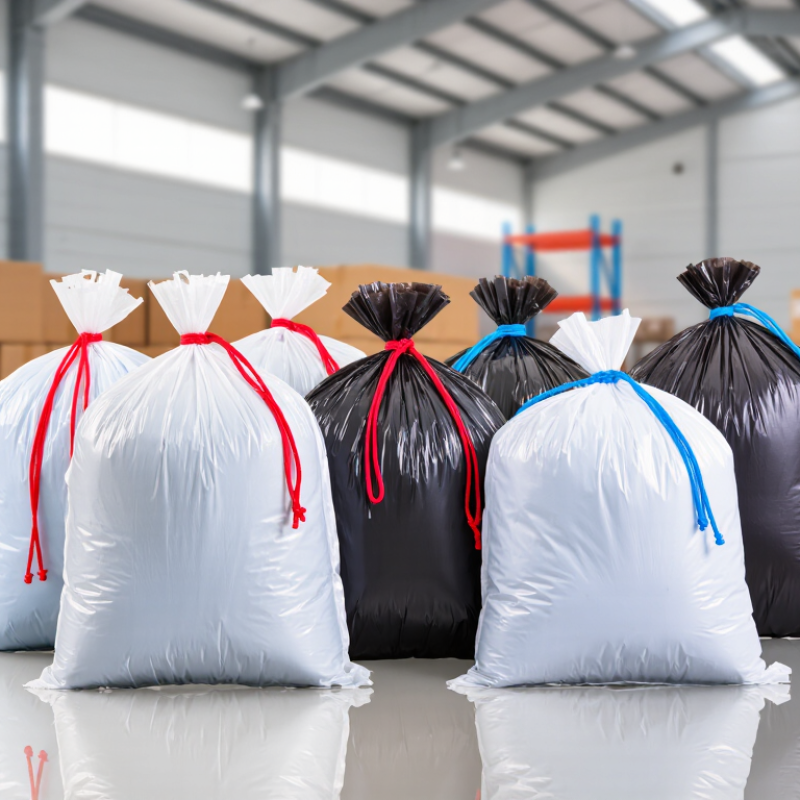
A leading drawstring trash bag supplier is defined by verifiable performance, not attractive catalog images. The supplier should provide film thickness, bag dimensions, load ratings, seal strength, and drawstring specifications. Independent testing matters. A bag that holds wet kitchen waste should not split when lifted from a narrow bin. That practical detail reveals more than a sales promise.
Environmental responsibility must also be measurable. The OECD’s Global Plastics Outlook reported 353 million tonnes of plastic waste in 2019, with packaging forming a major share. This pressure affects material selection and supplier accountability. Reliable suppliers should disclose recycled content, manufacturing energy data, and end-of-life limits. Claims such as “eco-friendly” are too vague. Testing against recognized standards is stronger evidence. UNEP’s 2023 Turning off the Tap report found that plastic pollution could be reduced by 80% by 2040 through reuse, recycling, and material changes. The supplier should explain where its bags fit within that system.
Consistency separates experienced manufacturers from occasional exporters. Buyers should review batch records, inspection procedures, production capacity, and corrective-action reports. Traceability is essential. A missing carton label can create avoidable confusion. I would also examine samples from several production lots, not one perfect sample. No supplier is flawless. However, a trustworthy supplier admits weaknesses, documents improvements, and responds clearly when specifications change. Pricing still matters, but the cheapest bag may create higher waste, complaints, and replacement costs. A leading supplier earns confidence through evidence, repeatable quality, and honest technical communication.
What Are the Top Drawstring Trash Bag Suppliers Worldwide?
Global suppliers stand out through consistent quality, dependable production, and clear communication. In practical sourcing, bag performance matters more than attractive catalogs. A reliable supplier should provide samples before large orders. Check drawstring strength, leak resistance, puncture performance, and sealing quality. A 60-liter bag should hold daily waste without stretching around the opening. Thickness alone does not guarantee durability. Poor film formulation can still cause splitting.
Experienced suppliers usually offer stable material specifications and documented quality checks. Factory audits can reveal storage conditions, production hygiene, and packaging controls. Ask about recycled content, batch traceability, testing records, and delivery capacity. Regional warehouses may reduce delays, but they do not replace production reliability. Communication matters too. Slow answers often become expensive problems later. No supplier performs perfectly in every area. Even strong manufacturers may face seasonal delays or occasional size differences. That deserves honest discussion, not exaggerated promises.
Tips: Request three production samples, not one. Test filled bags overnight. Compare knot strength, odor, carton labeling, and actual dimensions. Confirm minimum order quantities and replacement procedures in writing. A supplier that welcomes careful questions often supports a more dependable partnership. Still, buyers should review their own requirements regularly. Needs can change, and yesterday’s acceptable specification may become too weak tomorrow.
Global manufacturing regions that form the main supply base for drawstring trash bags
Asia represents the largest global plastics manufacturing base, followed by North America and Europe. For buyers of drawstring trash bags, these regions typically offer the broadest combination of polyethylene production, converting capacity, export infrastructure, and private-label manufacturing. The figures show regional shares of global plastics production and are used as a supplier-capacity proxy rather than company-specific sales data.
Source: OECD, Global Plastics Outlook, regional plastics production estimates for 2019.
Drawstring trash bag suppliers differ most in material choices. Low-density polyethylene usually feels soft and resists tearing around sharp household waste. High-density polyethylene is thinner, crisper, and often efficient for lighter loads. Recycled content can reduce virgin plastic use, but quality may vary between production batches. Ask for resin details, recycled percentages, and test data. Do not rely only on attractive sustainability claims.
Sizes also reveal how carefully a supplier understands real use. Small bags may fit bathroom bins, while larger versions suit kitchens, offices, and outdoor containers. Capacity labels can be confusing because manufacturers measure volume differently. Check the bag’s flat dimensions, usable depth, and opening width. I once accepted a stated capacity without testing the bin fit. That was a mistake. A sample filled with damp waste often gives more useful evidence.
Features separate basic products from dependable ones. Strong drawstrings should pull smoothly without separating from the cuff. Star-sealed bottoms can improve leak resistance, while thicker films may handle heavier waste. Some suppliers offer odor-control additives, color sorting, perforated rolls, or custom packaging. These options can increase cost and complicate recycling. Request samples from several suppliers, then test puncture resistance, knot strength, leakage, and storage performance. Warm warehouses and long sea shipments may affect flexibility. Supplier reliability also depends on consistent dimensions, clear inspection records, and honest lead-time updates. Claims need proof.
| Supplier Profile | Typical Supply Region | Common Bag Materials | Available Size Range | Typical Capacity | Drawstring Construction | Common Thickness Range | Key Features | Common Compliance Options | Best Suited For |
|---|---|---|---|---|---|---|---|---|---|
| Profile A | North America | Low-density polyethylene (LDPE), linear low-density polyethylene (LLDPE), and recycled polyethylene blends | Small office liners to extra-large contractor bags; approximately 15–95 gallons | 60–95 gal | Reinforced dual drawstrings or continuous drawstring channel | 0.8–3.0 mil, depending on bag size and application | High puncture resistance, odor-control options, star-sealed bottoms, colored liners, and large retail packs | Recycled-content claims, ASTM-based testing, and applicable food-contact documentation for suitable grades | Municipal programs, janitorial distributors, retail, and heavy-duty commercial waste collection |
| Profile B | Western Europe | Recycled polyethylene, post-consumer recycled (PCR) resin, and virgin polyethylene for demanding applications | Small bathroom bags through 120-liter commercial liners | 10–32 gal | Flat drawstring, soft-grip drawstring, or color-coded closure system | 15–70 microns, with thicker constructions for industrial use | High recycled content, compact rolls, perforated tear-off bags, reduced packaging, and color coding | EU packaging and waste requirements, EN 13592-related testing, and third-party recycled-content verification when specified | European retail, offices, hotels, healthcare support areas, and sustainability-focused procurement |
| Profile C | East Asia | HDPE, LDPE, LLDPE, recycled polyethylene, and biodegradable additive-based formulations | Kitchen, office, industrial, and extra-large sizes; approximately 10–120 liters | 13–32 gal | Single drawstring, double drawstring, or reinforced side-seal channel | 10–100 microns | Wide customization range, printed packaging, custom colors, embossed surfaces, and automated roll packing | ISO 9001 manufacturing systems are commonly available; product-specific compostability or recycled-content documents may be supplied | Private-label programs, large-volume importers, distributors, and customized promotional packaging |
| Profile D | South Asia | Virgin LDPE, LLDPE, recycled polyethylene blends, and material-saving thin-gauge films | Small household liners to 90-liter commercial bags | 8–24 gal | Standard drawstring, tie-handle drawstring, or looped drawstring | 15–80 microns | Competitive bulk pricing, custom dimensions, printed cartons, roll formats, and flexible minimum order quantities | ISO 9001 and customer-specific inspection reports are commonly offered; certifications depend on the product specification | Import wholesalers, hospitality suppliers, household products distributors, and price-sensitive markets |
| Profile E | Southeast Asia | LLDPE, LDPE, recycled polyethylene, and certified compostable resin for specific product lines | Household, food-service, retail, and commercial sizes; approximately 4–60 liters | 4–16 gal | Soft loop drawstring, integrated tie handles, or standard channel drawstring | 12–60 microns | Compact packaging, low-noise film options, compostable lines, leak-resistant seals, and color-coded sorting bags | Compostability certification may be available for qualifying products; food-contact suitability requires product-specific documentation | Food service, convenience retail, hospitality, and environmentally positioned household products |
| Profile F | Latin America | Virgin polyethylene, recycled polyethylene, and blended resin structures | Bathroom and kitchen bags through medium commercial liners; approximately 5–50 liters | 4–13 gal | Standard drawstring or integrated tie-handle closure | 15–70 microns | Strong color customization, bilingual packaging support, compact rolls, and household-oriented pack sizes | Local packaging and labeling requirements, recycled-content documentation, and customer-specific quality inspection | Supermarkets, household retailers, cleaning-product distributors, and regional private-label programs |
| Profile G | Middle East and North Africa | LLDPE, LDPE, high-density polyethylene (HDPE), and recycled polyethylene blends | Medium household bags to large commercial and industrial liners | 13–65 gal | Heavy-duty drawstring, reinforced channel, or tie-handle closure | 20–100 microns | Heat-resistant packaging options, strong seals, dark-color films, high-load designs, and multilingual labeling | ISO-based quality systems and destination-market labeling documents are commonly available upon request | Hotels, facility-management companies, construction support services, and commercial distributors |
| Profile H | Central and Eastern Europe | Post-consumer recycled polyethylene, LDPE, LLDPE, and virgin resin for premium applications | Household rolls through 120-liter waste sacks | 10–32 gal | Flat drawstring, reinforced drawstring, or integrated tie-handle closure | 20–80 microns | High recycled content, efficient roll packing, tear resistance, leak-resistant bottom seals, and retail-ready packaging | Recycled-content verification, EU chemical and packaging compliance, and product testing based on customer requirements | Retail chains, professional cleaning, institutional procurement, and sustainability-led tenders |
Note: Specifications represent commonly offered industry ranges. Actual dimensions, thickness, recycled content, certifications, minimum order quantities, and performance depend on the selected material grade, manufacturing process, destination market, and buyer requirements.
Quality begins with film thickness, tensile strength, puncture resistance, and seam performance. A bag that tears beside a wet kitchen bin creates extra waste and labor. Suppliers should provide batch test results, material specifications, and independent certifications. Price alone is misleading. Compare the cost per usable bag, not just the carton price.
The OECD’s Global Plastics Outlook reports that only about 9% of plastic waste was recycled globally in 2019. The 2023 UNEP report states that plastic pollution could be reduced by 80% by 2040 through existing solutions. Therefore, suppliers should disclose recycled content, resin origin, manufacturing energy, and end-of-life limits.
Recycled material may improve circularity, but it can also affect strength. That trade-off deserves testing. No scorecard is perfect.
Tips:
Request samples from several suppliers. Test them with wet, sharp, and heavy waste. Record leaks and breakage. Then calculate the delivered cost, including freight, storage, and replacement bags.
A lower quotation may hide thinner film or inconsistent sizing. I have seen procurement teams overlook this practical detail. It is a costly mistake.
Review sustainability claims against recognized standards and current laboratory reports before signing long-term contracts.
Choosing a drawstring trash bag supplier requires more than comparing quoted prices. In purchasing work, I have seen low bids fail when bags split at the kitchen bin or cords loosen during collection. Ask for samples in several thicknesses, then test them with wet food waste, sharp packaging, and repeated lifting. Check the seal, drawstring strength, odor, and fit around your actual containers. Small trials reveal more than polished catalogs. Request technical data for film thickness, bag dimensions, load limits, and packaging counts. A reliable supplier explains test methods clearly, not just promising “heavy duty” performance. Their answers should match the sample.
Evaluate production capacity and consistency. Request recent quality records, inspection photos, and a traceable batch system. Independent audits or recognized material certifications can support credibility, but verify their scope and expiry dates. Ask how they handle rejected rolls, color variation, and late shipments. Honest answers matter. I would also compare minimum order quantities, payment terms, tooling costs, and delivery routes. A cheap unit price can become expensive after storage, freight, or damaged cartons. Sustainability claims need evidence, such as recycled-content percentages and disposal guidance for the target market. Be careful with vague environmental language. Communication deserves a practical test: send a detailed inquiry and measure response time, accuracy, and willingness to correct misunderstandings. No supplier is perfect. A short pilot order, with written acceptance criteria, can expose weaknesses before a larger commitment.